Paris
Little WomenParis is both a vivid European destination and a turning point in the March family story: Amy Curtis March experiences it as a city of art, fashion, cafés, gardens, monuments, and social possibility, while Theodore Laurence makes it the setting for his quiet marriage to her. The city therefore joins two kinds of movement—Amy’s education in taste and Laurie’s movement from young companion to married man—and its pleasures are framed by the memory of Elizabeth March.
Amy’s European Paris
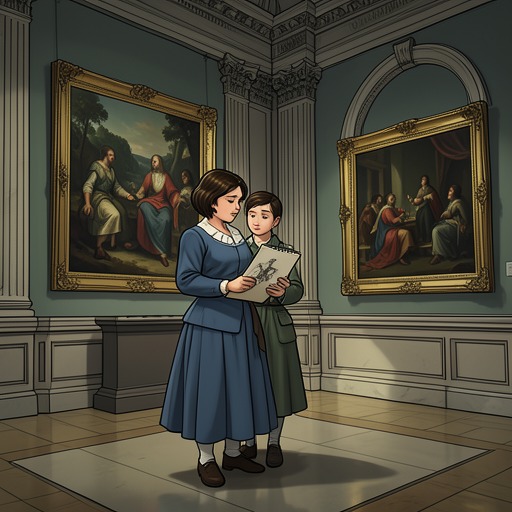
Amy Curtis March writes about Paris from within an extended European tour, carrying forward the social and artistic education begun in London. She describes days spent sightseeing, lunches in lively cafés, and amusing adventures, while rainy weather sends her to the Louvre, where she studies paintings with intense delight. Her account presents Paris as a city that rewards looking: art is not merely background decoration but a field in which Amy consciously cultivates her eye and taste.
The city also satisfies Amy’s interest in historical objects and famous figures. She contrasts her own enthusiasm for relics with Josephine March’s supposed preference for personal remains over fine art, recalling Napoleon’s cocked hat and gray coat, his baby’s cradle and old toothbrush, Marie Antoinette’s little shoe, the ring of Saint Denis, and Charlemagne’s sword. The detail makes Paris a museum of accumulated history, but it also reveals Amy’s particular way of possessing experience: she turns travel into knowledge, conversation, and a future performance of cultivated identity before her sisters.
Fashion, Society, and Desire
Paris exposes Amy to a world of luxury that she can admire without fully possessing. The Palais Royale is crowded with jewelry and beautiful objects, and its abundance nearly overwhelms her because she cannot buy what attracts her. Fred Vaughn offers to purchase some of these things, but Amy refuses the gift. Her response places a boundary around pleasure and courtship: she is alert to the social meaning of expensive presents even while the city makes their desirability vivid.
Her Paris is equally theatrical. She walks in the Bois and along the Champs Elysees, sees the imperial family, and records the emperor, empress, and the young prince in their carriage, surrounded by attendants and a mounted guard. The Tuileries Gardens provide another scene of public beauty, although Amy prefers the more antique Luxembourg Gardens. Even Pere Lachaise, with tombs arranged like small rooms containing tables, images, pictures, and chairs for mourners, becomes part of the city’s characteristic mixture of display, memory, and ceremony.
A Marriage in Paris
Paris is not only the setting of Amy’s travel narrative; it is where Laurie and Amy secretly marry. Laurie later explains that he and his grandfather had planned to return home with the Carrol family, but the Carrols changed their plans and decided to spend another winter in Paris. James Laurence wanted to return home, and Laurie could not leave him to travel alone. At the same time, Mrs. Carrol would not permit Amy to accompany Laurie without a chaperon, so Laurie proposed marriage as the practical solution to their conflicting obligations.
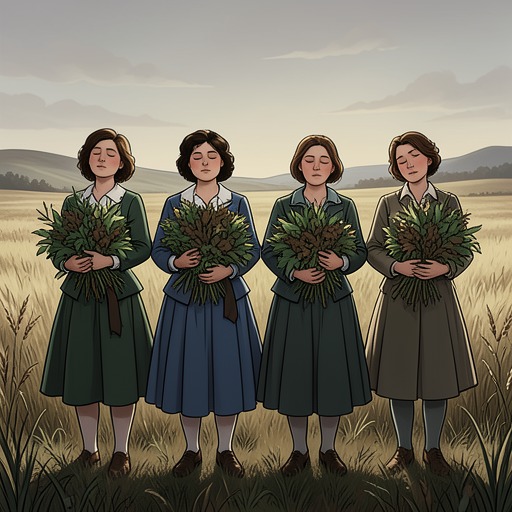
The wedding took place six weeks before Laurie’s explanation, at the American consul’s in Paris. It was deliberately quiet, partly because the couple were absorbed in their own happiness and partly because they had not forgotten Beth March. The location gives the marriage a formal public legitimacy while preserving its intimate, almost hidden character. Paris thus changes the meaning of Laurie and Amy’s relationship: what had been a developing attachment becomes an established family union, revealed only after the event to Jo and the rest of the March circle.
Paris and the Novel’s Spatial Pattern
Paris extends a recurring contrast between enclosed domestic spaces and expansive spaces of possibility. The March family home and the Laurence mansion are separated by a low hedge, a boundary that Jo crosses when she seeks friendship with the isolated Theodore Laurence. The hedge later becomes a playful post office where letters, manuscripts, books, and bundles pass between the neighboring households. Paris enlarges that movement across boundaries from a garden exchange into international travel and marriage.
The city also contrasts with the Laurence mansion’s apparent luxury. Theodore Laurence’s house contains a library lined with books, pictures, statues, cabinets of coins and curiosities, bronzes, and a large open fireplace, yet its abundance initially seems lifeless because few people enter or leave it. Paris offers Laurie and Amy a more mobile social world, but their marriage ultimately returns Laurie to James Laurence and connects travel back to family responsibility. The journey outward does not dissolve the domestic network; it reorganizes it.
Consequences and Lasting Significance
The Paris marriage helps produce the rapid family changes that follow. Soon afterward, Laurie is understood within a new household alignment with Amy and James Laurence, while Jo Curtis March recognizes the happiness of the family structures around her and imagines a family of her own. The novel’s later movement toward marriage, Plumfield, and the Bhaer household makes Paris a hinge between youthful uncertainty and settled kinship.
Paris consequently carries a double significance. For Amy, it is a place of museums, paintings, imperial spectacle, gardens, cafés, language difficulties, and luxurious objects—a school for artistic and social self-fashioning. For Laurie, it is the place where practical obstacles, family loyalty, and romantic commitment are resolved through marriage. Its most important transformation is therefore narrative rather than architectural: Paris begins as a city Amy explores and ends as the place where a relationship becomes part of the enduring family world.